
For the better part of a decade, the narrative surrounding Africa’s digital landscape was one of untamed potential, a booming, mobile-first market outpacing its own regulatory frameworks. Multinational corporations and regional enterprises alike operated in a gray area, where data privacy laws were either non-existent or treated as mere bureaucratic suggestions.
Today, that era is decisively over.
As we navigate the second quarter of 2026, the African data protection ecosystem has evolved from its infancy into a formidable, punitive force. With 44 African countries, roughly 80% of the African Union, now wielding enacted data privacy laws, the continent is actively shaping global data governance. For enterprise leadership, Chief Information Security Officers (CISOs), and Data Protection Officers (DPOs), understanding this shift is no longer a compliance exercise; it is a matter of corporate survival, accelerated by recent, highly publicized cybersecurity failures.

The Catalyst: The Alleged Remita and Sterling Bank Shockwaves
To understand the aggressive posture of regulators today, one must look at the immediate crises driving them. In March and April of 2026, the fragility of Nigeria’s digital financial ecosystem was laid bare.
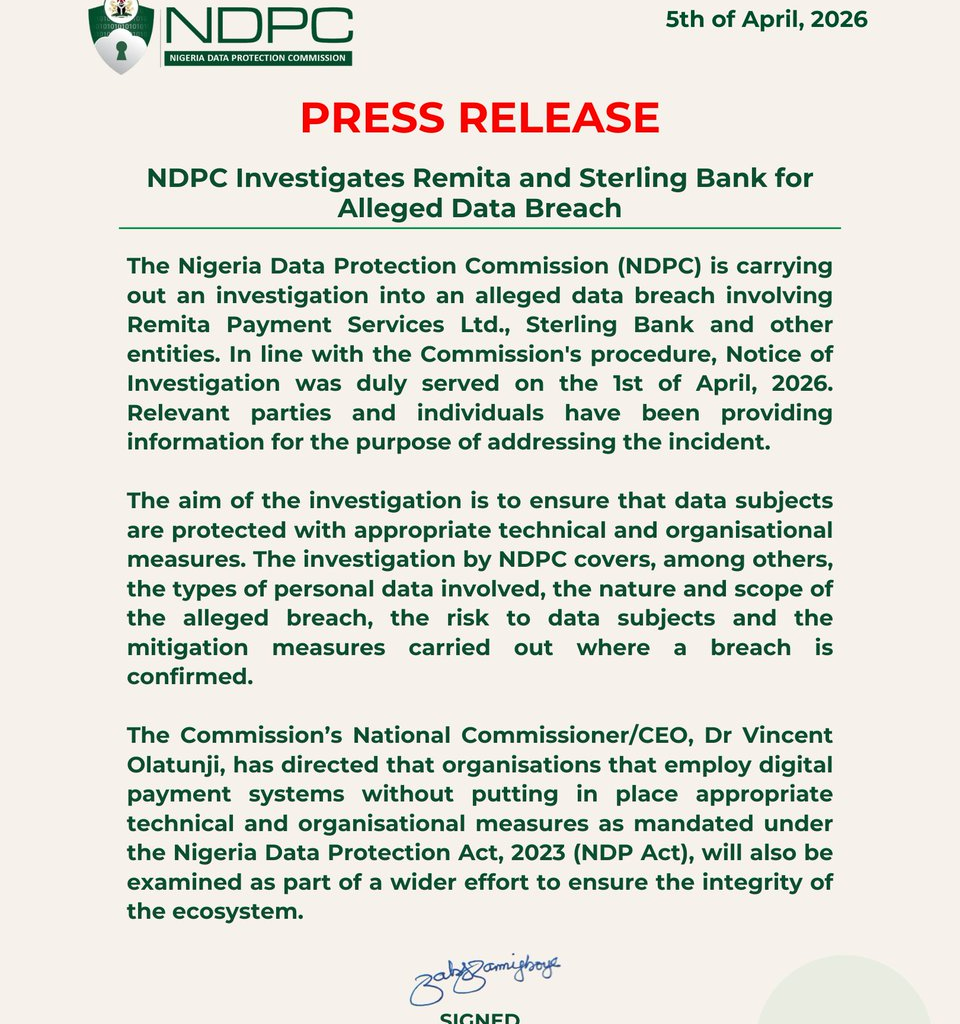
A dark web threat actor known as “Bytetobreach” unleashed dual shockwaves, claiming extensive compromises of both Sterling Bank and Remita, the latter being a critical backbone of Nigeria’s government and commercial payment processing. The leaked datasets reportedly included deeply sensitive KYC (Know Your Customer) documents, Bank Verification Numbers (BVNs), transaction histories, identity records, and raw SQL databases.
The sheer scale of these alleged breaches, potentially exposing the personal and financial data of millions of citizens, forced the Nigeria Data Protection Commission (NDPC) to issue formal Notices of Investigation on April 1, 2026. These incidents were not just data leaks. They were a systemic wake-up call proving definitively that compliance on paper means absolutely nothing without robust, operational cybersecurity defending the perimeter.
Mitigating the Threat: A Blueprint for Resilience
The shortcomings exposed by the alleged Remita and Sterling Bank breaches highlight a critical reality: traditional, reactive security measures are dead. To prevent a repeat of these catastrophic events, enterprises operating in Africa must pivot to aggressive, proactive mitigation strategies:
- Implement Zero-Trust Architectures: The traditional castle-and-moat security model is obsolete. Organizations must assume their networks are already compromised. Zero-Trust mandates strict identity verification for every person and device trying to access resources, heavily limiting lateral movement if a threat actor breaches the outer perimeter.
- Advanced Cryptography and Salting: The Remita leak notably exposed user password hashes. Relying on outdated hashing algorithms allows hackers to use dictionary attacks and brute-force software to decrypt data. Organizations must upgrade to robust cryptographic algorithms and mandate end-to-end encryption for all sensitive data, both at rest and in transit.
- Continuous Security Validation (Penetration Testing): Annual audits are insufficient against persistent dark web operators. Enterprises must employ continuous red-teaming and automated penetration testing to identify and patch vulnerabilities, particularly in APIs and cloud storage buckets, before hackers can exploit them.
- Automated Incident Response (IR): Under the Nigerian Data Protection Act’s GAID (General Application and Implementation Directive), organizations have a strict 72-hour window to report breaches. Relying on manual threat hunting guarantees failure. Implementing AI-driven Security Information and Event Management (SIEM) systems ensures rapid detection, containment, and regulatory reporting.
The Macro-African Shift: From Enactment to Executive Liability
The fallout from these breaches is accelerating a profound shift across the continent: the piercing of the corporate veil. Regulatory bodies and the judiciary have lost patience with the slap-on-the-wrist administrative fines that previously defined corporate data breaches.
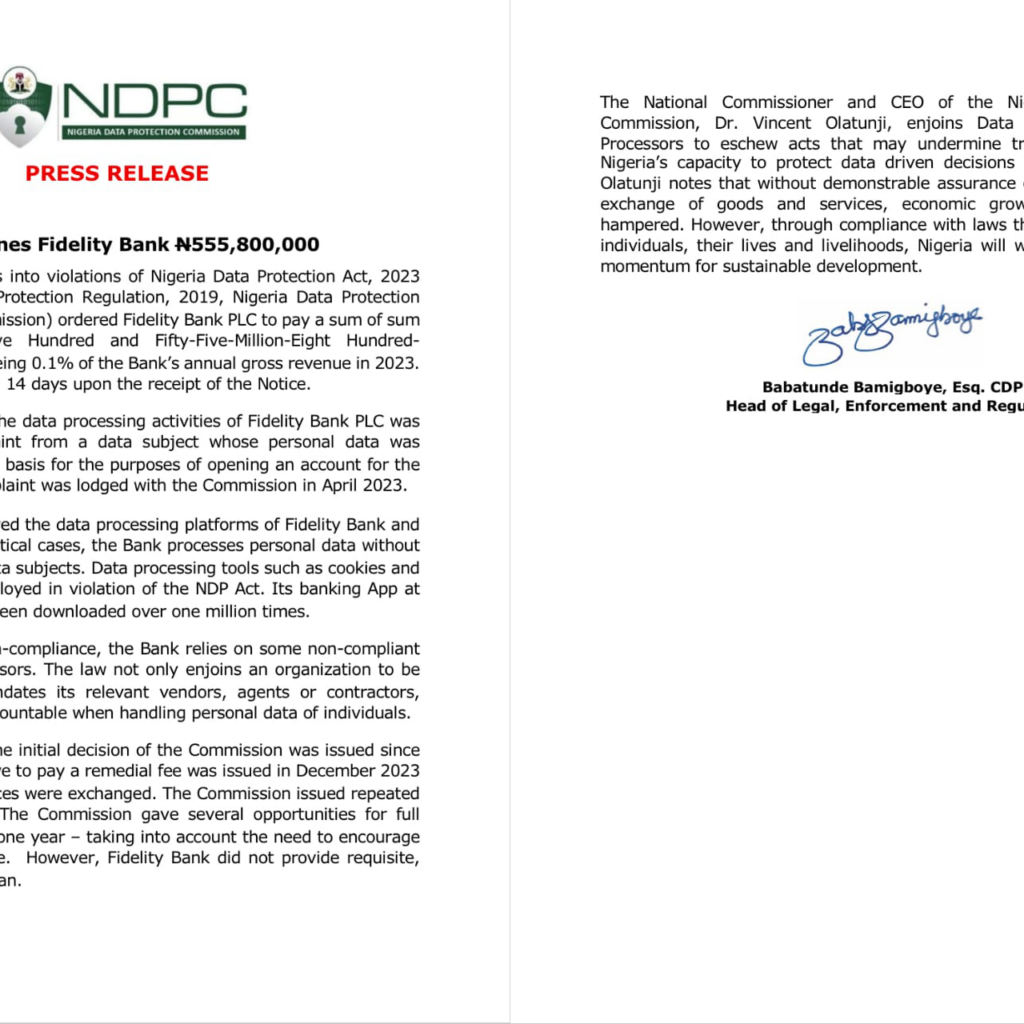
We are witnessing an unprecedented rise in personal liability for the C-suite. Recent criminal convictions for gross data offenses in East Africa and heavy fines (such as the ₦555.8 million fine levied against Fidelity Bank by the NDPC in 2024) signal a radically elevated risk profile. Furthermore, the traditional silos of regulation are breaking down. Competition authorities, particularly within the COMESA bloc and South Africa, are increasingly treating the insecure accumulation of user data as a metric of anti-competitive dominance, blending antitrust enforcement directly with privacy oversight.
The Next Frontier: AI Governance and IoT Security
As baseline data protection laws reach critical mass, forward-thinking regulators are already expanding their crosshairs to target emerging technologies. The year 2026 is shaping up to be the year of Artificial Intelligence regulation in Africa.
Nigeria is, once again, leading the charge. The highly anticipated National Digital Economy and E-Governance Bill aims to establish a super-regulator framework. This legislation is designed to codify the ethical processing of data via machine learning, demanding algorithmic transparency and combating automated bias. Other nations, including Angola, Morocco, and Kenya, are fast-tracking parallel AI bills to prevent the continent from becoming a testing ground for unregulated, opaque AI models.
Alongside AI, the sheer volume of biometric data collection, driven by national identity programs and fintech expansion, has made biometric security a mission-critical vector. Securing these localized networks against the increasingly sophisticated DDoS (Distributed Denial-of-Service) and ransomware attacks seen in Q1 2026 is the top priority for national cybersecurity agencies.
The Mandate for Enterprise Leadership
The African regulatory landscape of 2026 requires a fundamental strategic pivot. Data privacy must be elevated from the IT basement to the boardroom. DPOs must be empowered, adequately resourced, and given a direct reporting line to the board to mitigate the looming threat of personal executive liability.
In this new era, regulatory compliance is not a static checkbox; it is a dynamic, aggressive discipline. Those who treat it as such will secure consumer trust and dominate the market. Those who do not will find their data on dark web forums and face the uncompromising teeth of Africa’s new digital guardians.
In conclusion
The rules have changed. The penalties are real. And the next breach headline is closer than you think. This is what the Dataleum Intelligence is built for, cutting through the noise to give enterprise leaders, compliance officers, and digital decision-makers the signal that matters. Explore our full library of intelligence reports for industry insights.