
If you still think Nigerian universities are only competing through rankings, research output, and accreditation badges, you’re missing the biggest plot twist in higher education today.
A new battleground has quietly emerged.
It’s fast.
It’s loud.
It’s public.
And it’s shaping the reputation of universities long before anyone fills out an application form.
Welcome to the new arena: Social Media.
Nigeria’s Universities Are Competing in a New Arena — And the Results Are In
Today’s prospective students do not just rely on brochures or campus tours. They scroll. They watch. They compare. A university’s online presence often becomes the first impression and sometimes, the deciding factor.
Alumni are rebuilding their sense of community through digital spaces. Parents form opinions based on what institutions post (or don’t post). And the public now expects universities to speak, engage, and show their culture in real time. Social media is not just a communication tool anymore; it has become a core part of every institution’s identity and influence.
So we did something bold: we tracked and ranked the social media performance of 50 Nigerian universities, using real data, real engagement metrics, and verified accounts.
The results?
Let’s just say… some universities are punching far above their weight.
The Top Performers: Meet the Universities Dominating the Digital Space
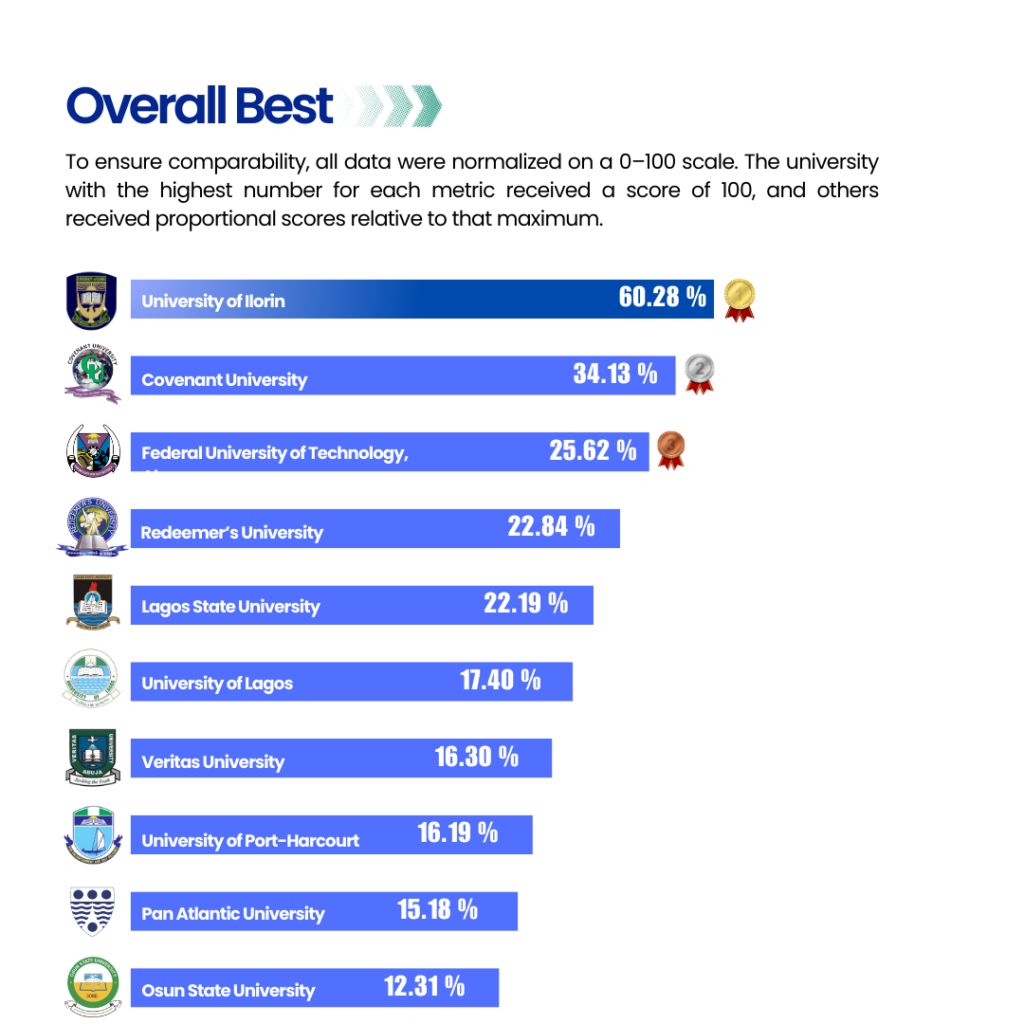
Three institutions refused to be ignored across every major platform:
Their strength has nothing to do with chance. They post consistently, interact with their audiences, and understand what their communities want to see. The University of Ilorin performs strongly on Facebook, LinkedIn, and X, showing a well-balanced, multi-platform strategy. Covenant University thrives on X, where it remains agile and consistently part of national conversations. FUTA maintains strong engagement across visual and professional platforms, reflecting its tech-forward personality.
These institutions are not just present online, they are active, intentional, and influential.
Private vs Public Universities: Same Game, Different Strengths
The data makes one thing clear: private and public universities are thriving on different social platforms, each playing to its unique strengths.
Private universities clearly dominate Instagram. Their feeds are filled with sharp visuals, modern aesthetics, and high-energy student life. Institutions like Covenant University, Babcock University, Redeemer’s University, and Veritas University understand how to capture the attention of Gen Z with content that feels fresh, relatable, and visually appealing.
Public universities, on the other hand, hold a strong lead on Facebook. With their large alumni communities and broad, diverse audiences, schools such as UNILORIN, Bayero University Kano, and the University of Port Harcourt consistently create content that resonates with older users, long-time followers, and wider community groups.
Each sector is excelling on the platforms where its community naturally thrives, showing a smart alignment between audience behaviour and content approach.
Engagement Matters More Than Follower Count
A major insight from the report is that follower numbers no longer tell the whole story. Some universities with massive audiences recorded weaker engagement, while smaller institutions outperformed through authentic, consistent interaction.
Quality of connection is now more valuable than size of audience.
The universities winning today are the ones that understand their communities, respond quickly, and produce content that feels human, timely, and relatable.
Old School vs New School: A Generational Shift in Influence
Older institutions such as Ahmadu Bello University, the University of Lagos, and the University of Benin benefit from decades of history and expansive alumni communities. Their long-standing legacy gives them a broad digital reach and strong institutional influence.
Millennial universities like FUTA and Lagos State University occupy a middle ground. They blend traditional academic culture with more contemporary digital communication styles, making their online presence a balanced mix of structure and modern relevance.
Then there are the Gen Z universities, including Covenant University and the American University of Nigeria. These institutions move quickly, experiment boldly, and create visually dynamic content that resonates with younger audiences. Their energy and adaptability set them apart in the fast-paced world of digital engagement.
Together, these generational layers give Nigeria’s digital education landscape a unique blend of authority, creativity, and fresh perspectives.
Why This Report Matters
This ranking shows that digital relevance is becoming just as important as academic strength. Students care about what a university looks like online. Parents care about transparency and communication. Alumni care about connection. And the public cares about how institutions show up during national conversations; with photographers, videographers, or graphic designers to offer complete content packages.
Click here to read the full report.

At Dataleum, we are committed to equipping Africans with the skills that make them globally competitive. Our programs are designed to prepare you for opportunities anywhere in the world whether that’s in Silicon Valley, Lagos, or remote roles with global companies.
Enroll in a Dataleum program today and start building the career that travels with you.